

UGC NET Paper 1 Research Aptitude: 10 Solved PYQs with Explanations (June 2025)
Research Aptitude questions reward clear definitions. If you can tell pure research from applied, and exploratory from explanatory, most of this unit is within reach. Below are 10 real UGC NET Paper 1 questions from June 2025. Try each one first, then open the answer to see why it is right and why the other options fail.
- Read the question and choose your answer before opening anything.
- Tap Show answer and explanation to check yourself.
- Note the wrong-option reasons. Those are the traps examiners reuse.
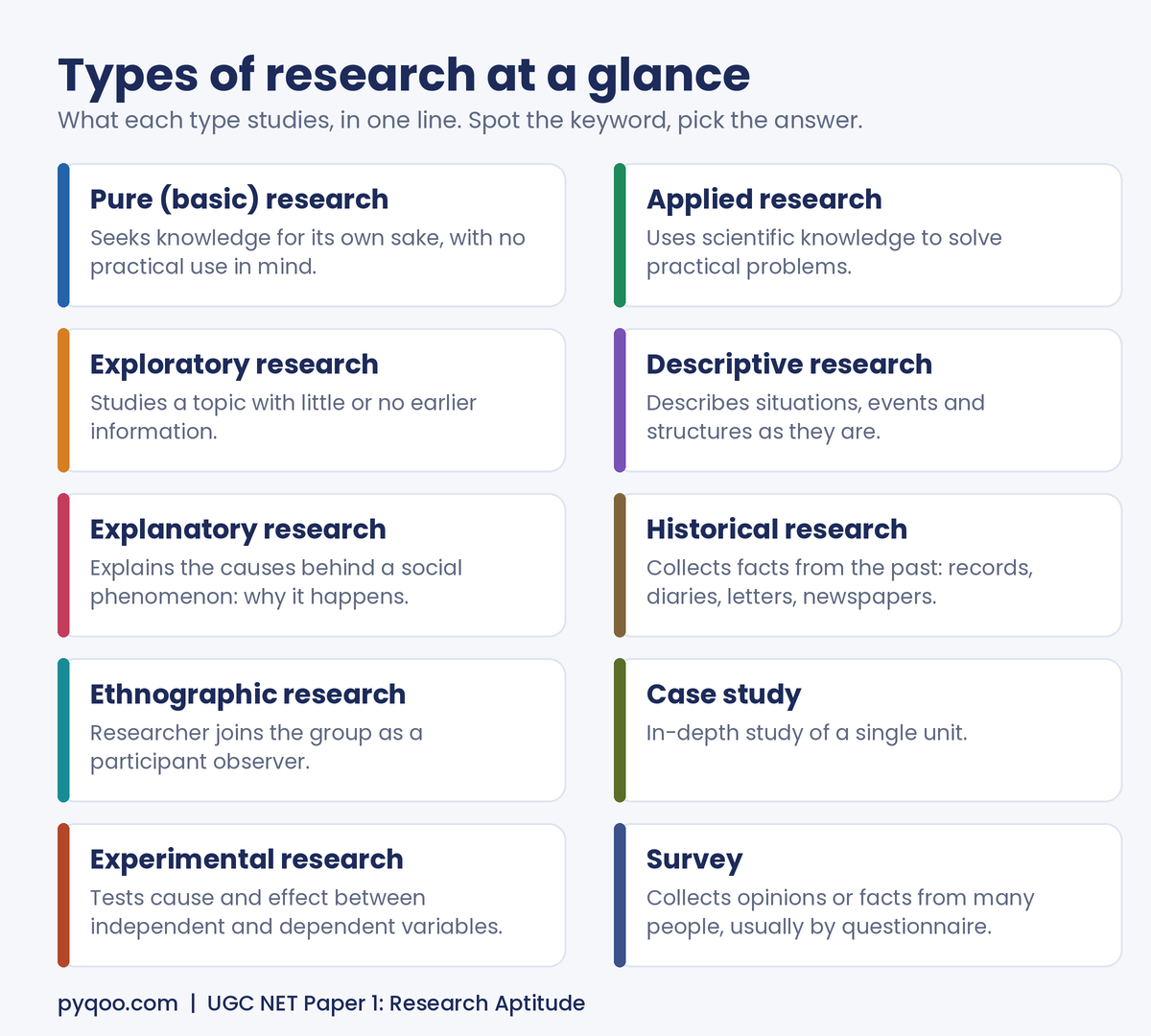
Types of research at a glance
Most definition questions in this unit come from the ten types below. Save this picture for revision.
10 solved questions
Scientific Observations are based on _________.
- Verifiable evidence or systematic body of proof that can be cited.
- Accumulated experiences
- Prejudices
- Beliefs of the people
Show answer and explanation
Correct answer: A. Verifiable evidence or systematic body of proof that can be cited.
Why: Scientific observation rests on systematic, verifiable and citable evidence, unlike common experience, prejudice or belief.
- A Correct. Scientific observation needs verifiable, systematic evidence.
- B Accumulated experience is common-sense knowledge, not scientific evidence.
- C Prejudices are unscientific biases.
- D Beliefs are not verifiable evidence.
What is not a Research?
- Research is a careful and exhaustive investigation of a phenomenon with an objective of advancing knowledge.
- It is a systematic and objective attempt to study a problem for the purpose of deriving general principles.
- Research is based on common sense knowledge, based on the accumulated experiences and beliefs of the people.
- It is a systematic investigation to find solutions to a problem.
Show answer and explanation
Correct answer: C. Research is based on common sense knowledge, based on the accumulated experiences and beliefs of the people.
Why: Research is systematic, objective and evidence-based. Relying on common sense, accumulated experience and popular belief is not research.
- A This is an accepted definition of research.
- B Systematic, objective study to derive principles is research.
- C Correct. Common-sense belief lacks systematic investigation.
- D Systematic investigation to solve problems is research.
Spot the trap: the question asks what is not research. Anything resting on common sense, belief or accumulated experience fails the test.
What is Exploratory Research?
- It describes social situations, social events, social systems, social structures etc. The researcher observes/studies and then describes what did he find?
- It studies subject about which either no information or the limited information is available.
- It explains the causes of social phenomena. Describing the magnitude and nature of crimes committed by females in India is one aspect of female crime but why do they commit crime is its explanatory aspect.
- It is based on common sense knowledge based on the accumulated experiences and beliefs of the people.
Show answer and explanation
Correct answer: B. It studies subject about which either no information or the limited information is available.
Why: Exploratory research studies subjects about which little or no information exists, to gain familiarity and insight.
- A This describes descriptive research.
- B Correct. Exploratory research studies little-known subjects.
- C This describes explanatory research.
- D This describes common-sense knowledge, not research.
What is pure research?
- It is concerned with search for ways of using scientific knowledge to solve practical problems.
- It does not develop and test hypothesis and theories.
- This research is not used to reject or support the existing theories about social phenomena.
- It is also called basic research and is concerned with quest for knowledge and knowing more about the phenomenon without concern for its practical use.
Show answer and explanation
Correct answer: D. It is also called basic research and is concerned with quest for knowledge and knowing more about the phenomenon without concern for its practical use.
Why: Pure (basic) research seeks knowledge for its own sake, without concern for immediate practical use.
- A This describes applied research.
- B Pure research does develop and test hypotheses and theories.
- C Pure research is used to support or reject theories.
- D Correct. Basic research seeks knowledge without practical aim.
Pure vs applied: pure research asks “what is true?”, applied research asks “what works?”
What is Historical Research method?
- It collects facts by understanding the present situation. Sources of information include interviews of experts, surveys etc.
- It collects facts by predicting the future. Sources of information include questionnaire, telephonic interviews etc.
- It collects facts by going in the past in different periods. Sources of information include written records, newspapers, diaries, letters, traveler’s accounts, documents, etc.
- It collects facts by using common sense and also tries to solve practical problems. Sources of information include surveys and interviews.
Show answer and explanation
Correct answer: C. It collects facts by going in the past in different periods. Sources of information include written records, newspapers, diaries, letters, traveler’s accounts, documents, etc.
Why: Historical research collects facts about the past from records, newspapers, diaries, letters, travellers’ accounts and documents.
- A This describes survey or descriptive research.
- B Historical research looks at the past, not the future.
- C Correct. It studies the past through written records.
- D Common-sense problem solving is not historical research.
In which type of research, researcher observes the subjects by being a part of their group?
- Action research
- Ethnographic research
- Descriptive survey
- Experimental research
Show answer and explanation
Correct answer: B. Ethnographic research
Why: Ethnographic research involves the researcher joining the group as a participant observer to study its culture.
- A Action research aims to solve practical problems.
- B Correct. Participant observation is the ethnographic method.
- C Descriptive surveys collect data from samples.
- D Experimental research manipulates variables.
What is a questionnaire?
- It is data analysis instrument.
- It is a data collection instrument.
- It is data comparing instrument.
- It is the analysis and result finding instrument.
Show answer and explanation
Correct answer: B. It is a data collection instrument.
Why: A questionnaire is a set of written questions used to collect data from respondents.
- A Analysis is done after collection, not by the questionnaire.
- B Correct. It is a data collection instrument.
- C It does not compare data.
- D It does not analyse results.
The next question is about the order of steps in classroom action research. This picture shows the sequence.

Arrange the steps of classroom action research
- (a) Plan
- (b) Reflect
- (c) Action
- (d) Observe
- (e) Follow up
- (b), (a), (c), (e), (d)
- (c), (b), (e), (d), (a)
- (a), (c), (d), (b), (e)
- (d), (e), (a), (c), (b)
Show answer and explanation
Correct answer: C. (a), (c), (d), (b), (e)
Why: Classroom action research follows a cycle: plan, act, observe, reflect, and follow up.
- A Starts with Reflect. You cannot reflect before you have acted and observed.
- B Starts with Action. A plan must come first.
- C Correct. Plan, Act, Observe, Reflect, Follow up.
- D Starts with Observe. There is nothing to observe before you plan and act.
Memory trick: P-A-O-R-F = Plan, Act, Observe, Reflect, Follow up.
Match List – I with List -II:
| List-I | List-II |
|---|---|
| (a) Experimental Research | (I) In depth study of a single unit |
| (b) Ethnographic Research | (II) Study of opinions of people towards social media |
| (c) Survey | (III) Cause and effect relationship between independent and dependent variables |
| (d) Case study | (IV) Study of the perception of the people of a particular group regarding their life |
- (a)-(IV), (b)-(III), (c)-(II), (d)-(I)
- (a)-(III), (b)-(IV), (c)-(II), (d)-(I)
- (a)-(III), (b)-(I), (c)-(IV), (d)-(II)
- (a)-(II), (b)-(IV), (c)-(I), (d)-(III)
Show answer and explanation
Correct answer: B. (a)-(III), (b)-(IV), (c)-(II), (d)-(I)
Why: Experimental research studies cause and effect, ethnographic research studies a group’s perceptions of life, a survey studies opinions, and a case study is an in-depth study of a single unit.
- A Swaps experimental and ethnographic research.
- B Correct. Experimental (III), Ethnographic (IV), Survey (II), Case study (I).
- C Pairs case study with opinions on social media, which is a survey.
- D Pairs experimental research with opinions on social media, which is a survey.
Memory trick: Experimental = cause and effect, Ethnographic = a group’s way of life, Survey = opinions, Case study = one unit.
Research misconduct includes which of the following?
- (a) Data fabrication
- (b) Plagiarism
- (c) Data falsification
- (d) Differences of opinion
- (e) Data validation
- (a), (b), (c) and (e) Only
- (c), (d) and (e) Only
- (d) and (e) Only
- (a), (b) and (c) Only
Show answer and explanation
Correct answer: D. (a), (b) and (c) Only
Why: Research misconduct includes data fabrication, data falsification and plagiarism. Differences of opinion and data validation are normal research activities.
- A Includes (e) data validation, which is a normal research step.
- B Includes (d) and (e), neither of which is misconduct.
- C Both (d) and (e) are acceptable research activities.
- D Correct. Fabrication, plagiarism and falsification.
Memory trick: misconduct is F-F-P: Fabrication, Falsification, Plagiarism.
Quick revision table
| Type | Core idea | Keyword to spot |
|---|---|---|
| Pure (basic) | Knowledge for its own sake | “without concern for practical use” |
| Applied | Solves practical problems | “using scientific knowledge to solve problems” |
| Exploratory | Little or no earlier information | “limited information is available” |
| Descriptive | Describes what exists | “observes and then describes” |
| Explanatory | Explains causes | “why” |
| Historical | Facts from the past | “records, diaries, letters, newspapers” |
| Ethnographic | Researcher joins the group | “participant observer” |
| Case study | One unit in depth | “single unit” |
| Experimental | Cause and effect | “independent and dependent variables” |
| Survey | Opinions from many people | “questionnaire” |
Three traps to watch for
- “Which is NOT research?” The answer is usually the option built on common sense, belief or accumulated experience.
- Pure vs applied. If the option mentions solving a practical problem, it is applied research.
- Exploratory vs explanatory. Exploratory means little is known. Explanatory means you are asking why.
Frequently asked questions
Is Research Aptitude important in UGC NET Paper 1?
Research Aptitude is one of the ten units in the Paper 1 syllabus. Many of its questions test definitions, types and steps, so a short, well-organised set of notes can earn marks quickly.
How do I tell pure research from applied research?
Pure research aims at knowledge for its own sake. Applied research uses that knowledge to solve a practical problem. Look for words such as “practical” or “solve” in the option.
Are these real exam questions?
Yes. They are from UGC NET Paper 1, June 2025 (25 to 28 June shifts). The explanations are written by the Pyqoo team.
Practise 100 free questions, easy ones first
UGC NET Paper 1 questions with explanations and option-by-option reasons.
Start free practiceQuestion wording follows the June 2025 UGC NET Paper 1 question papers. Explanations are original to Pyqoo.